What if your startup could turn predictions into profits?
In today’s data-driven world, prediction markets are quickly becoming one of the most exciting opportunities for startups to innovate, engage users, and generate revenue. Instead of just building another app, imagine creating a platform where users actively trade on real-world outcomes, bringing together insights, opinions, and financial incentives in one place.
That’s where prediction marketplace development enters. With the right software solution, startups can launch powerful platforms that handle everything from real-time trading and dynamic pricing to secure transactions and outcome verification.
But here’s the catch, not all solutions are built the same. Choosing the right prediction market software can make the difference between a platform that struggles… and one that scales rapidly.
In this blog, we’ll explore the best prediction market software solutions for startups, helping you understand what to look for, what features matter, and how to build a platform that stands out in this fast-growing space.
What is a Prediction Market?
A prediction market is a platform where people trade or bet on the outcome of future events. Instead of just guessing what might happen, users put money (or tokens) behind their predictions making it a mix of forecasting and trading.
The idea is simple:
The more accurate your prediction, the more you can earn.
Prices in a prediction market change based on what people believe will happen. This means the market itself reflects the probability of an event, using the collective intelligence of all participants.
Real-Life Example
Imagine a prediction market with the question:
“Will Bitcoin reach $100,000 this year?”
You believe the answer is Yes, so you buy “Yes” shares
Another user thinks No, so they buy “No” shares
As more people join, the price of each option changes based on demand
If “Yes” shares are priced at $0.70, it means the market believes there’s a 70% chance it will happen.
Now, if Bitcoin actually reaches $100,000:
Everyone who bought “Yes” shares wins
Each winning share might pay $1
The difference becomes your profit.
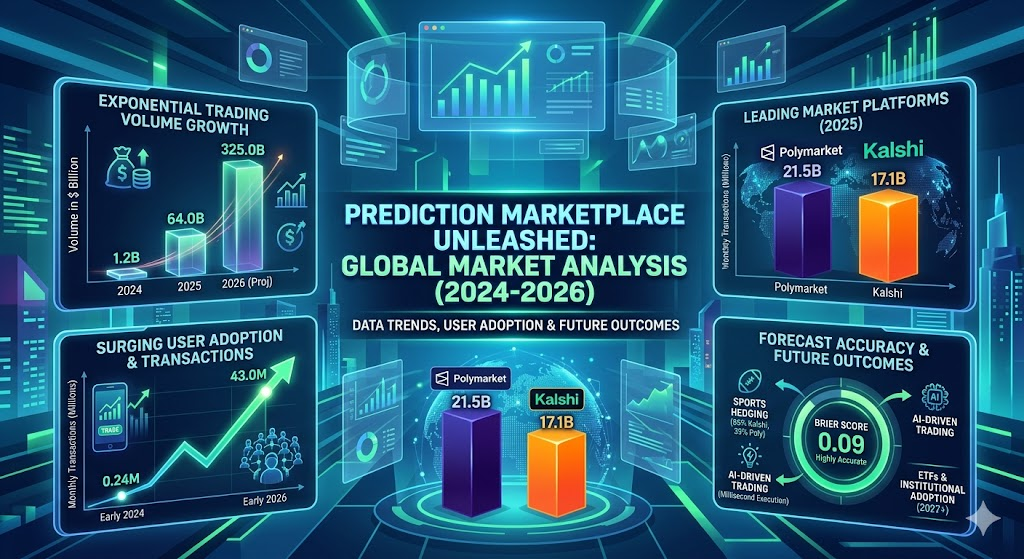
What Statistics Say About Prediction Markets? Surprising Insights
Prediction Marketplace Development
Prediction marketplace development is no longer just an interesting concept; it’s becoming a powerful digital business model where insights, opinions, and real-world events turn into measurable value.
Imagine this way: instead of users passively consuming content, they actively participate in predicting outcomes, trading on possibilities, and engaging with data in real time. This shift is exactly why startups and enterprises are investing in robust prediction market software to build platforms that are not only interactive but also highly scalable.
A strong prediction marketplace isn’t just about placing bets, it’s about creating a flawless ecosystem. From real-time trading engines and dynamic pricing to secure payment systems and accurate outcome resolution, modern prediction market software solutions bring everything together into one intelligent platform.
The result? A system that evolves continuously based on user behavior and market trends.
What makes this space even more exciting is its versatility. Whether it’s forecasting crypto prices, sports results, political outcomes, or business trends, prediction market software can be adapted across industries making it a flexible and future-ready solution.
Prediction marketplace development is about building platforms where collective intelligence drives engagement and revenue. With the right technology in place, you’re not just launching a product, you’re creating a dynamic marketplace that grows smarter, faster, and more valuable over time.
Best Prediction Market Software Solutions for Startups
If you’re a startup exploring prediction market software solutions, here’s the reality this space isn’t just growing, it’s exploding with real traction, real users, and real money flowing in.
Let’s break it down in a way that actually matters
Why Startups are Rushing into Prediction Market Software?
Over the last 2–3 years, prediction markets have shifted from niche experiments to mainstream digital platforms.
- Global trading volume reached $63.5 billion in 2025, up from $15.8 billion in 2024
- Monthly trading volume crossed $13 billion, growing nearly 130x in just two years
- Active users surged from ~4,000 to 600,000+, showing massive adoption
Even major financial players are stepping in. For example, the parent company of the NYSE recently invested $600 million into a prediction market platform, signaling strong institutional confidence.
What Makes a “Best” Prediction Market Software Solution?
The best prediction market software typically includes:
Real-time trading engine – Handles dynamic price movements instantly
Scalable architecture – Supports rapid user growth and high traffic
Secure wallet & payment integration – Ensures smooth transactions
Accurate data/oracle systems – Verifies real-world outcomes
Analytics dashboards – Helps users make smarter predictions
Why Timing Matters?
Here’s what the data tells us:
- Prediction markets recorded $44B+ total trading volume in 2025
- Top platforms control 85%–90% of global activity, leaving room for innovation
- Transactions jumped from 240K to 43M+, proving deep user engagement
For startups, this is the perfect window to enter with differentiated prediction market software solutions.
Polymarket: The Liquidity King
Polymarket remains the undisputed heavyweight of decentralized markets. In early 2026, it reached a milestone of 840,000 unique monthly wallets, with a single-day volume record of $425 million on February 28.
The 2026 Shift: It has moved beyond pure crypto-native users through a major partnership with X (formerly Twitter). Polymarket odds are now integrated into Grok’s real-time analytics, giving startups a massive distribution blueprint to study.
Startup Takeaway: If you are building a "Polymarket clone," focus on their hybrid model. They use on-chain settlement but off-chain order books to keep the UI fast. Their "secret sauce" for 2026 is geopolitical markets (like US-Iran tensions), which have actually overtaken sports in total volume.
👉 This is exactly why many startups are now exploring a polymarket clone script, to replicate its success while customizing features for niche markets like sports, finance, or AI predictions.
2. Kalshi: The Regulated Powerhouse
Kalshi has successfully positioned itself as the "grown-up" in the room. In 2025, it processed $23.8 billion in total notional volume, showing 1,100% year-over-year growth.
The 2026 Shift: Kalshi now acts as the backend infrastructure for Robinhood’s event contracts. This "Infrastructure-as-a-Service" model is a huge hint for startups: you don't always need to be the storefront; you can be the provider.
Regulatory Reality: Despite its success, Kalshi is currently facing a "patchwork" of legal battles in 2026. States like Massachusetts and Nevada have issued temporary bans or injunctions specifically against their sports-based contracts.
Startup Takeaway: Kalshi’s valuation hit $22 billion in March 2026. They prove that institutional money (led by firms like Coatue) is willing to pay a premium for a platform that plays by the CFTC rules.
👉 Startups targeting institutional users or regulated markets often look at a Kalshi clone script to build platforms that align with legal frameworks while maintaining strong performance.
3. Augur & Gnosis/Omen: The Infrastructure Layer
While Polymarket and Kalshi dominate the retail "frontend," these older protocols have evolved into specialized backends.
Augur (REPv2): In 2026, Augur has largely transitioned into an open-source toolset. While the REP token still exists (trading around $0.97 with a $7.6 million market cap), the "Augur" brand is now heavily used by developers for software analytics and decentralized oracle services rather than a consumer betting app.
👉 For startups looking to build Web3-native platforms, an Augur market clone script is often a great starting point, especially if your focus is on decentralization, trust, and censorship resistance.
Gnosis / Omen: Gnosis is no longer just a "prediction market." It’s a full ecosystem (Gnosis Chain) that hosts other markets. Startups use Gnosis Protocol v1 because it offers "permissionless market creation," meaning anyone can launch a market without asking for approval, a feature Kalshi lacks.
What if the next big opportunity in tech isn’t something people use but something they actively participate in and profit from?
That’s exactly where prediction markets are headed. With the rapid rise of market prediction software and the growing demand for data-driven decision-making, startups now have a unique chance to build platforms that are not just engaging but revenue-generating ecosystems.

Final Take- Why You Must Start Now?
The truth is, the space is still early, but momentum is building fast. Users are looking for smarter ways to interact with information, and platforms powered by the best trading prediction software are already proving how powerful this model can be. From real-time insights to dynamic trading experiences, the potential is only getting bigger.
So why start now?
Because the first movers in this space won’t just capture users, they’ll shape how the entire market evolves.
👉 The real question isn’t “Is this the right time?”
👉 It’s “How fast can you launch with the right market prediction software?”
Because in a world driven by data, the platforms that turn predictions into opportunities will lead the future.